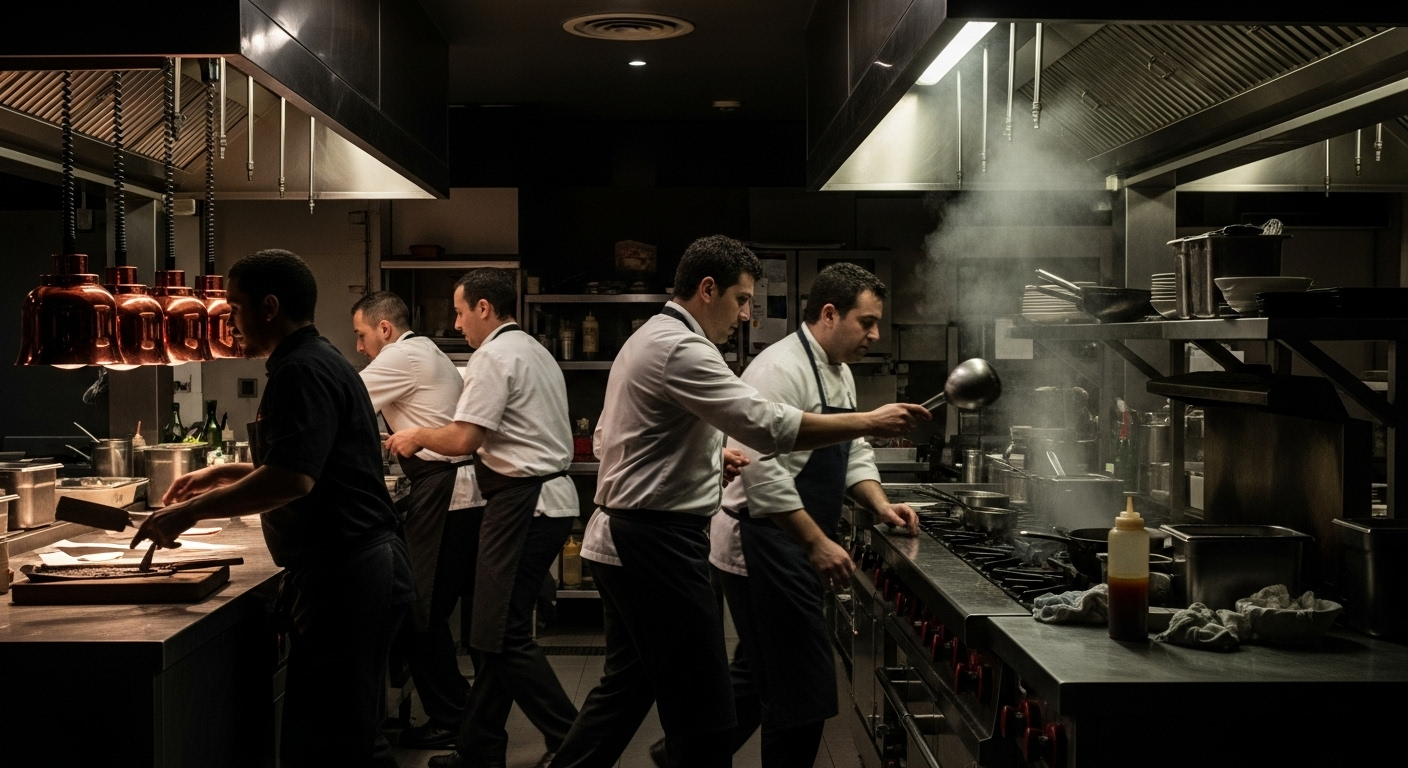
You've probably been there. A star waiter who leaves without a word, that unbearable tension in the kitchen during the rush, or the feeling that the team simply isn't pulling together. As a restaurant owner, it's very easy to put it all down to the stress of the job. But what if I told you these aren't isolated problems — they're the cracks in a deeper issue that's quietly eating into your profits without you even noticing? We're talking about workplace culture.
Forget the idea that it's an abstract or "soft" HR concept. The environment you create in your restaurant is one of your greatest financial assets — or one of your biggest liabilities. Let's be clear: workplace culture is a key indicator of how well your business is doing, full stop. We'll show you the direct connection between your team's morale and the figures in your bank account. And most importantly, we'll give you a plan to build an environment that doesn't just keep good people around, but turns them into the true engine of your growth.
Beyond the smile: what workplace culture in hospitality really means
When we hear "workplace culture", we almost always picture people smiling and getting along. And while that's part of the goal, there's much more to it — and it can be measured. Workplace culture is what the whole team feels about where they work. It's not an isolated opinion, but the result of how things are done, the norms, and the management style that shapes their day-to-day. Think of it as the personality of your restaurant, but seen from the inside by the people who live it.
In hospitality, this environment depends on several very important factors. First, there's communication — ensuring instructions are clear and there's space to share ideas or raise concerns. Then leadership, which determines whether managers inspire, merely issue orders, or aren't even around. Next comes recognition, which isn't just about pay, but about feeling that your efforts are valued. And of course, working conditions, ranging from fair shift patterns to having the right tools and a safe environment. Ignoring all this is like navigating without a compass: you're moving, yes, but you're most likely heading anywhere but where you want to go.
The invisible connection: how a poor working environment drains your business's profitability
The link between a burnt-out team and less money in the till isn't a theory — it's a fact. A poor working environment doesn't just create discontent; it causes money to haemorrhage through three channels that, while not always obvious at first glance, leave a tremendous mark on your monthly accounts.
First, there's the hidden cost of staff leaving. Every time an employee walks out the door, a hole opens up in your finances. The most obvious expense is finding a replacement: job adverts, interviews, and paperwork. But the real blow comes later. Imagine that replacing one waiter costs you around €1,500, between recruitment and training. If 70% of your 15-person team leaves every year, you could be losing nearly €16,000 a year on that alone. And on top of that, the new person takes time to get up to speed, and the experience of the person who left is gone for good. A strong workplace culture is the best way to keep people around and protect that money.
Then there's the issue of rock-bottom productivity. A demotivated employee won't come close to performing at their best, and in a restaurant that shows immediately. Service slows down and you turn fewer tables. There are more order errors, which means wasted food and higher costs. People stop bothering with upselling and cross-selling, and you lose the opportunity to increase the average spend. A Cornell University study confirmed it: investing in your people's wellbeing improves your numbers. When communication breaks down and nobody receives a word of encouragement, the team disengages and the efficiency that drives profit goes out the window.
And finally, the customer experience, which is a mirror of your team. Customers don't know if there's trouble in the kitchen or at the staff meeting, but I assure you they feel it. A stressed, disengaged, or fractious team transmits that negative energy directly through the service. Genuine warmth — the kind that wins loyal customers and five-star reviews — can't be faked for long. It comes from a team that feels valued and content. A poor environment translates into forced smiles, curt responses, and bad service. With so much competition, the experience you offer is what makes you stand out. And that experience is simply a reflection of the environment inside your walls. If your people aren't well, your customers won't be either.
Indicators that don't lie: how to take the temperature of your team
To improve the working environment, the first step is to stop treating it as something intangible. You need to start measuring it with the same rigour you apply to food costs or covers served. Fortunately, there are very clear signals that give you a perfect picture of how healthy your team really is.
The most direct signals are the ones that jump out at you. The number of people who leave each year is probably the clearest indicator that something is seriously wrong. If a lot of people are walking out, it's not a coincidence. Absences and sick days, whether justified or not, are also red flags. They can signal anything from burnout — what's known as burnout — to total disengagement from work. It's essential to track these figures to spot any patterns.
Then there are the indirect signals, which require a closer look. Is productivity slipping? Perhaps it's taking longer to serve each table or you're processing fewer orders per hour. Look at the number of kitchen errors or till discrepancies. Pay attention to customer complaints. Quite often, a spike in negative reviews about the service coincides with a period of intense internal stress. Cross-referencing your business data with your HR data will give you the full picture of what's going on.
And of course, the most direct way to gauge the atmosphere is to ask. But doing it properly takes some thought. Climate surveys — always anonymous so people feel safe being honest — are a great tool. You can use rating questions from 1 to 5 alongside open questions about management, communication, or whether people feel recognised. But never underestimate the power of a face-to-face conversation. A coffee with a team member or a chat in the corridor can give you far more information than any questionnaire, provided you've created an environment where people feel safe to speak up.
From theory to action: practical strategies to transform your workplace culture
Knowing what's happening is just the beginning. Real change comes when you roll up your sleeves with a clear, consistent plan to make your restaurant a place where people genuinely want to work and stay. It doesn't have to cost a fortune — the key lies in a shift in mindset and improvements to everyday practices.
Change has to start at the top. A good leader is one who inspires, communicates clearly, sets realistic expectations, and gives feedback to help people improve — not to tear them down. The idea is to move from a "do as I say" approach to one built on trust, where managers act more like coaches than watchdogs. And that means being present in the thick of the action, genuinely listening, and being the first to lead by example in everything.
It's vital that communication flows and is transparent. The team needs to know what's happening in the business, what the goals are, and how their work contributes to achieving them. Introducing quick five-minute meetings before service — the well-known briefings — to get everyone on the same page can work wonders. Just as important is having a clear, safe channel through which people can raise concerns without fear of getting a dressing-down. This is where effective staff management that actually works becomes crucial for organising shifts, tasks, and internal communication without losing your mind.
Finally, it's vital that you focus on recognising good work and helping people grow. Pay matters, of course, but it isn't everything. Praising good work publicly, providing training to develop new skills, or creating a path for progression within the restaurant are things that give you far more back than they cost. In doing so, you show your team that they're not just a number — they're a valued asset in whom you believe and on whom you're building the future. This creates a loyalty and commitment that money alone simply can't buy.
Stopping seeing your team as a cost and starting to see them as the heart of your business: that's the mindset shift that separates restaurants that merely survive from those that truly thrive. The atmosphere in your restaurant is just as important as the menu you serve. It shows in every dish, every smile, and ultimately in your accounts. Caring for the environment isn't a secondary task; it's the primary task. Because a united, motivated team that feels valued doesn't just save money and work better — it becomes your best marketing and the reason your customers will keep coming back.